
Last updated: November 2026.
Tokyo hosts three of Japan's six Grand Sumo tournaments every year, and the Japan Sumo Association has already published the dates for 2027. This guide gives you the official dates and ticket release days for each Tokyo tournament, explains how a tournament day unfolds from the first morning bout to the final ceremony, and shares practical tips for building your trip around it.
2027 Tokyo sumo tournament dates
Grand Sumo tournaments, called honbasho, are the official 15-day competitions held six times a year. Three of the six are held in Tokyo at the Ryogoku Kokugikan, Japan's national sumo stadium, next to JR Ryogoku Station. The results of these tournaments decide the rankings of professional wrestlers. These are the official 2027 dates:
January tournament: Sunday, January 10 to Sunday, January 24, 2027. Tickets go on sale Saturday, December 5, 2026. Rankings announced December 21, 2026.
May tournament: Sunday, May 9 to Sunday, May 23, 2027. Tickets go on sale Saturday, April 10, 2027. Rankings announced April 26, 2027.
September tournament: Sunday, September 12 to Sunday, September 26, 2027. Tickets go on sale Saturday, August 7, 2027. Rankings announced August 30, 2027.
The rankings are published on the banzuke, the official ranking sheet, two to three weeks before each tournament. The ticket dates above are the general sale on Ticket Oosumo, the official ticket site, which also has an English version. Note that the Japan Sumo Association is revising ticket prices for Tokyo tournaments starting in January 2027, so please check current prices on the ticket site. Our guide to buying sumo tickets in Tokyo breaks down the purchase step by step.
The other three 2027 tournaments are held in Osaka (March 14 to 28), Nagoya (July 11 to 25), and Fukuoka (November 14 to 28). If your trip misses all of them, see how to watch sumo when there is no tournament.
Weekends and holidays during the 2027 Tokyo tournaments
Weekend and holiday tickets cost a little more and tend to sell out first. Here are the days to keep in mind:
January: January 10, 11 (Coming of Age Day, a national holiday), 16, 17, 23, and 24.
May: May 9, 15, 16, 22, and 23. The tournament starts four days after Golden Week, Japan's early-May holiday period, which ends on May 5.
September: September 12, 18, 19, 20 (Respect for the Aged Day), 23 (Autumnal Equinox Day), 25, and 26.
What a tournament day looks like
One ticket covers the whole day, from the first match in the morning to the last one in the early evening. In sumo, a single match is called a bout. According to Ticket Oosumo, bouts start in the morning, the main matches of the top-division wrestlers start around 2 p.m., and the day finishes around 6 p.m. Here is the order of the day:
Morning: the lower divisions. The day opens with the youngest and lowest-ranked wrestlers, moving up through the four lower divisions: jonokuchi, jonidan, sandanme, and makushita. The arena is quiet and mostly empty, which makes it a relaxed time to explore the building. In 2026, doors opened at 8:45 a.m. on days 1 to 12.
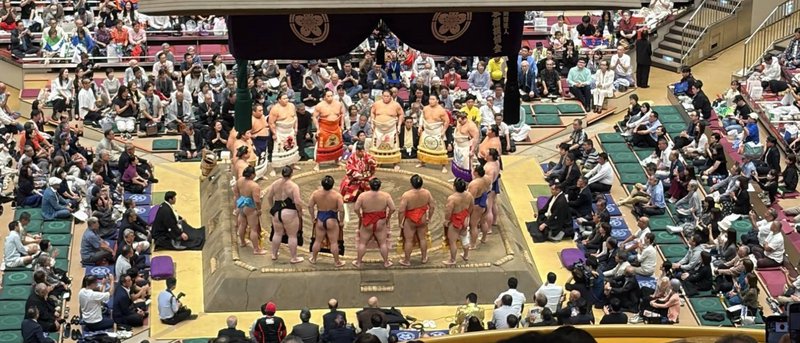
Afternoon: the juryo division. Juryo is the second-highest division and the first rank of fully professional, salaried wrestlers. Its wrestlers walk into the ring in a ring-entering ceremony, called dohyo-iri, wearing embroidered ceremonial aprons, and then their bouts begin.
Late afternoon: the makuuchi division. Makuuchi is the top division, where the sport's biggest names compete. It opens with its own ring-entering ceremony, followed by the ring-entering ceremony of the yokozuna, sumo's highest rank, if one is competing. The arena is fullest from here on.
Around 6 p.m.: the final bout and the bow ceremony. After the last bout of the day, a wrestler performs the yumitori-shiki, a ritual dance with a bow that closes the day. As you leave, you will hear the hane-daiko, a drum played outside the stadium to invite spectators back the next day.
An insider's tip from the Japan Sumo Association's own guidebook: the top-division wrestlers enter the ring from the east side on odd-numbered days and from the west side on even-numbered days, so the side of the arena that gets the closest view of the ceremony changes daily.
The last three days run on a later schedule. In 2026, doors opened at 10:30 a.m. on days 13 and 14 and at 10:00 a.m. on the final day. These are also the days when the championship race is decided, so they are among the hardest tickets to get.
How to plan your trip around a Tokyo tournament
Mark the sale date before anything else. If your trip overlaps a tournament, the ticket sale date is the first deadline, often more than a month before you fly. Weekday tickets in the first week are usually the easiest to get.
Plan a stop at a Seven-Eleven. Tickets bought on the English site can only be printed at a Seven-Eleven store in Japan, so print them before your sumo day.
Watch morning practice before the tournament, not during it. Stable practice pauses while a Tokyo tournament is running. The weeks just before the tournament are the best time to see wrestlers training. See our guide to watching sumo morning practice.
Leave your luggage at the cloakroom. On a check-out day, you can still go: in 2026 the Kokugikan ran a paid cloakroom on the first floor from 10:00 to 18:00 that takes large suitcases and coats.
Read up on the venue. Our Ryogoku Kokugikan guide covers seat types, access, and the Sumo Museum.
Tips for the day
Decide when to arrive. If you only want to watch the top wrestlers, arriving in the early afternoon is enough. If you want the full experience, come in the late morning, eat, and watch the arena fill up.
Know the re-entry rule. In 2026, you could leave and come back once per day through the South Gate, returning by 17:00. Keep your ticket stub, or for a QR ticket, show the screen.
Eat chanko in the basement. Chanko is the hearty hot pot sumo wrestlers eat. At the September 2026 tournament it was served in the basement hall from 11:00 to 16:30 for ¥1,350 a bowl, made to a different stable's recipe each tournament.
Visit the Sumo Museum. During Tokyo tournaments the museum inside the Kokugikan opens from 12:30 to 16:00, and you need a tournament ticket to enter.
Follow the spectator etiquette. The Japan Sumo Association asks spectators to stay quiet at the moment the wrestlers charge, avoid moving around during bouts, avoid blocking the view of people behind them, and not whistle, heckle, or throw objects. Folding floor chairs are not allowed.
Bring a ticket for every child aged 4 and over. There is no child discount on standard tickets.
Add a hands-on sumo experience to your trip
A tournament shows you sumo from the stands. To see it up close, or to try it yourself, Alva Japan Tours runs two sumo experiences in Ryogoku that work alongside a tournament visit or on dates when there is no tournament:
Ryogoku Sumo Show & Workshop with Chanko Lunch: 2 hours, ¥13,000 per adult and ¥9,000 per child aged 2 to 5. Former professional sumo wrestlers demonstrate techniques and an exhibition bout a few meters away, you learn basic moves such as shiko (the leg-raising stomp), an optional ring challenge is open to anyone who wants to try, and you finish with a chanko lunch. Rated 4.9 out of 5 by over 500 guests. It runs year-round, so check the start time when you book if you want to pair it with a tournament day.
Private Sumo Morning Practice & Ring Experience: a private visit to watch real morning practice with an English- or Japanese-speaking guide. ¥38,000 per person to watch (1 hour 30 minutes, minimum 4 guests), or ¥52,000 per person including a beginner-friendly ring experience (2 hours, minimum 3 guests). Because practice pauses during tournaments, book it for the weeks before one.
For every way to experience sumo in the city, see our complete guide to sumo in Tokyo.
Frequently asked questions
When are the sumo tournaments in Tokyo in 2027?
January 10 to 24, May 9 to 23, and September 12 to 26, 2027, all at the Ryogoku Kokugikan. These dates come from the Japan Sumo Association's official schedule.
When do tickets go on sale for the 2027 Tokyo tournaments?
December 5, 2026 for January, April 10, 2027 for May, and August 7, 2027 for September, on the official Ticket Oosumo site. For past tournaments, the English site opened sales at 10:00 a.m. Japan time.
How long should I spend at a sumo tournament?
Plan at least three to four hours if you want to see the top division, arriving in the early afternoon. Fans who want the full day arrive in the morning and stay until the bow ceremony around 6 p.m.
Can I buy sumo tickets on the day?
Only if tickets for that day have not sold out. If they sell out in advance, no tickets are sold at the venue, so buy ahead if seeing a tournament matters to you.