Last updated: October 2026.
Sumo wrestling is Japan's national sport, and Tokyo is where it lives: three of the six annual Grand Sumo tournaments, the national sumo stadium, and dozens of the stables where wrestlers live and train. But "seeing sumo in Tokyo" covers a lot of ground, from watching a tournament from the stands to stepping onto a real sumo ring yourself. This guide covers all of it: what is available, when, and how to choose between watching, visiting a stable, or joining a hands-on workshop.
Is there a sumo tournament in Tokyo right now?
Tokyo hosts three of Japan's six annual Grand Sumo tournaments (honbasho), in January, May, and September. Each runs for 15 days at the Ryogoku Kokugikan, the national sumo stadium in Tokyo's Ryogoku district, where the top professional sumo wrestlers compete. Outside those months there is no tournament in Tokyo, and that is when a guided sumo experience becomes the better option: it does not depend on the tournament calendar at all.
Grand Sumo tickets are sold out: what are my options?
Weekends and the final days of each tournament often sell out weeks ahead. If you can't get a ticket, or your dates don't line up with a tournament, you have two realistic alternatives in Tokyo:
Watch sumo wrestlers train (asa-geiko). Sumo stables (heya) hold morning practice year-round, and a small number open their doors to visitors through guided access. A few stables, including Arashio stable in Nihombashi, have a street-facing window where passersby can watch training from outside for free, without a reservation, though there is no guarantee a session is running on any given day.
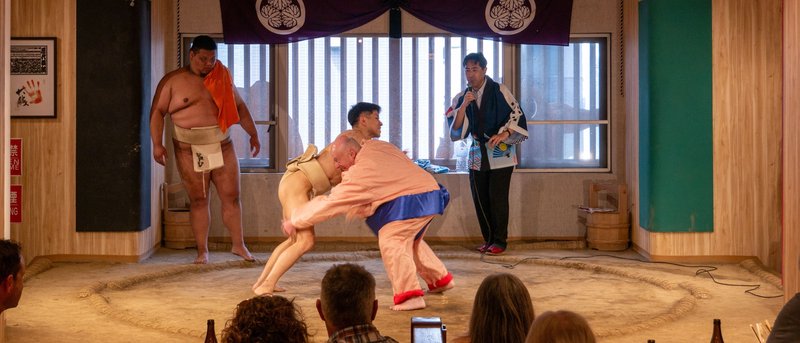
Book a hands-on sumo workshop with a live exhibition bout. Several operators in Ryogoku run workshops on a real dohyo (the raised clay ring sumo is fought on) that combine basic training with a short exhibition match. No tournament ticket is required, and they run year-round.
Guided sumo experience vs. buying tournament tickets directly: which is worth it?
If you want to enjoy a tournament during your trip, buying tickets directly (through the official Japan Sumo Association site or the box office) is cheaper and works fine, especially if you already understand how sumo wrestling works. A guided experience is worth paying for when:
You want an English-speaking host to explain the rituals, rules, and etiquette as they happen, rather than guessing from a program.
Your dates don't match a tournament, so tournament tickets aren't an option.
You want more than watching: training on a real sumo ring, meeting wrestlers, or taking photos with them, none of which a spectator ticket includes.
Alva Japan Tours' sumo experiences
Ryogoku Sumo Show & Workshop with Chanko Lunch: from ¥13,000 per person, 2 hours, Ryogoku
Runs year-round regardless of the tournament calendar. Former professional sumo wrestlers show you how sumo works up close, then teach basic moves on a real sumo ring in a group setting, with an optional ring challenge for anyone who wants to try. Lunch is chanko nabe, the hot pot sumo wrestlers eat to build strength; vegetarian, vegan, allergy-related, and no-pork or no-alcohol requests can be made when booking. No sumo knowledge or special clothing is needed, and the venue is wheelchair and stroller accessible. Rated 4.9 out of 5 by over 500 guests, it is the option we recommend for families with kids, teens, or grandparents.
Private Sumo Morning Practice & Ring Experience: from ¥38,000 per person, 1 hour 30 minutes, Ryogoku
A private visit to watch sumo wrestlers' morning practice up close, with a guide explaining what you are seeing as it happens. Because it is private, there is no shared schedule or crowd, which suits a couple or a small group that wants an unhurried view rather than a group workshop. The viewing-only option is ¥38,000 per person. For ¥52,000 per person, you can also step into the ring, learn basic movements from an instructor, and try a safe push practice.
What to know before your first sumo experience in Tokyo
You don't need to know the rules. Every Alva sumo experience opens with a plain-language explanation of what is about to happen, so you don't need to have watched sumo wrestling before.
Photography rules differ by setting. At a stable's morning practice, photography is often restricted or allowed only in silence out of respect for the wrestlers. At a workshop, photos are usually encouraged, including with the wrestlers.
Dress comfortably. No special clothing is required for either experience above. Closed-toe shoes are recommended if you plan to try the hands-on training.
Book stable visits well ahead. The stables themselves limit morning practice access, so availability is tighter than for the Ryogoku workshop.
Frequently asked questions
Where is sumo held in Tokyo?
Grand Sumo tournaments are held at the Ryogoku Kokugikan in the Ryogoku district, Tokyo's historic sumo neighborhood. Sumo stables, where wrestlers live and train together, are spread across Tokyo, with several around Ryogoku itself.
How much does it cost to experience sumo in Tokyo?
Tournament tickets bought directly start at a few thousand yen for arena seats. Guided experiences with Alva Japan Tours start at ¥13,000 per person for the Ryogoku sumo show and workshop. A private morning practice visit is ¥38,000 per person, or ¥52,000 with a ring experience.
Can I watch sumo wrestling in Tokyo outside tournament months?
Yes. Stable morning practice and hands-on workshops both run year-round, independent of the tournament schedule. See "Grand Sumo tickets are sold out" above.
Is a sumo experience suitable for kids and families?
Yes. The Family Sumo Workshop is designed for mixed-age groups, with no prior experience or athletic ability required.