
Last updated: November 2026.
If you search for sumo in Tokyo, you will quickly run into "sumo shows," "sumo tours," "sumo experiences," and "morning practice." They sound alike, but they are very different things, with prices ranging from free to ¥50,000 per person. This guide explains what a sumo show actually is, the main types you can book in Tokyo, and how to choose one for your budget, your group, and your schedule.
What is a sumo show?
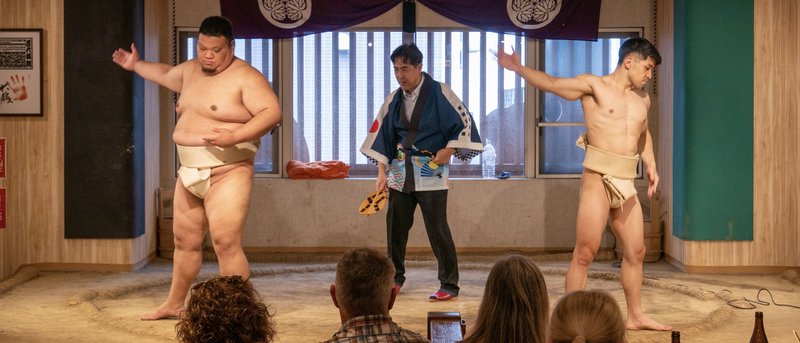
A sumo show is a live exhibition performed by former professional sumo wrestlers, usually on a real dohyo, the raised clay ring that sumo is fought on. It is not an official Grand Sumo tournament. Instead, the wrestlers demonstrate training moves and techniques up close, explain the rules and rituals, stage an exhibition bout, and often invite guests to step into the ring.
That difference matters. At a tournament at the Ryogoku Kokugikan, you watch active professional wrestlers, called rikishi, compete for rank, often from far away. At a sumo show, you sit a few meters from the ring, can ask questions, and usually eat chanko, the hearty hot pot that sumo wrestlers eat to build their bodies. Tokyo only hosts tournaments in January, May, and September, so for most visitors a sumo show is the realistic way to see sumo. If your dates do match a tournament, see our guide to buying sumo tickets.
The main types of sumo shows and sumo tours in Tokyo
1. Sumo show and workshop with chanko lunch
This is the classic daytime format: a demonstration by former wrestlers, a hands-on workshop, photos, and a chanko lunch. It suits first-timers and families because guests take part rather than only watch.
Alva Japan Tours runs the Ryogoku Sumo Show & Workshop with Chanko Lunch in Ryogoku, Tokyo's sumo neighborhood. Here is what you get:
Price: ¥13,000 for ages 6 and up, ¥9,000 for ages 2 to 5, free for ages 0 to 1 (tax included)
Length: About 2 hours
Program: An introduction to the rules, basic moves such as shiko (the high leg stomp) and suri-ashi (sliding footwork), close-range technique demonstrations, an exhibition bout, an optional ring challenge, and photos with the wrestlers
Lunch: A chanko hot pot lunch, with vegetarian, vegan, allergy, and no-pork requests possible if sent 48 hours ahead
Language: Hosted in English and/or Japanese
Access: Wheelchair and stroller accessible; groups from 1 to 36 guests
It is rated 4.9 from 509 reviews (as of November 2026).
2. Restaurant-style sumo shows
Some restaurants have their own ring and stage sumo shows alongside a meal, notably in Asakusa. The format is closer to dinner theater: you eat at your table while former wrestlers perform, and some guests are invited to challenge a wrestler in a padded sumo suit. Shows typically run about 2 hours, with several sessions a day from lunchtime to late evening. On the official pages we checked in November 2026, standard seats with a chanko meal cost ¥16,000 per adult and front-row seats ¥20,000, while premium plans with wagyu dishes and free-flowing drinks reach ¥30,000 to ¥50,000. Choose this if you want an evening activity or a bigger meal.
3. Morning practice viewing
Watching asa-geiko, the early morning training at a sumo stable (heya, where wrestlers live and train), is not a show at all. You can watch real active wrestlers train in silence, with no commentary during practice and no hands-on part unless the visit includes it. Street viewing through the windows of Arashio Stable in Nihonbashi is free, while guided visits inside a stable cost more. Our private Sumo Morning Practice & Ring Experience is ¥38,000 per person to watch (1 hour 30 minutes) or ¥52,000 with a ring experience (2 hours), for one private group per day, with a minimum group size. Stables leave Tokyo for the March, July, and November tournaments, so check your dates first. Our morning practice guide covers timing and etiquette.
Quick comparison
Show and workshop with chanko lunch: Price per adult: From ¥13,000. Length: About 2 hours. Food: Chanko lunch. Best for: First-timers, families, hands-on.
Restaurant-style show: Price per adult: ¥16,000 to ¥50,000. Length: About 2 hours. Food: Chanko or a full course. Best for: Evenings, dinner with a show.
Morning practice (street): Price per adult: Free. Length: As long as you like. Food: None. Best for: Budget travelers, early risers.
Morning practice (private, guided): Price per adult: ¥38,000 to ¥52,000. Length: 1.5 to 2 hours. Food: None. Best for: Seeing real professional training.
How to choose the right sumo show
Budget: A daytime show with lunch is the most affordable way to see sumo up close with food included. Premium restaurant plans cost several times more, mostly for the meal and drinks.
Kids: Look for child pricing and a hands-on part. Morning practice requires children to sit still and quiet for a long time, which is hard for small kids. At our Ryogoku show, children aged 2 to 5 are ¥9,000 and must stay with an adult.
Language: The commentary is what makes a sumo show meaningful. Check that English explanation is included, not only the performance.
Time of day: Morning practice starts early, workshops with lunch fill the middle of the day, and restaurant shows run into the evening.
Location: Ryogoku is the home of sumo, with the national stadium and many stables nearby, so it pairs well with the Sumo Museum. See our Ryogoku Kokugikan guide. Asakusa suits travelers combining a show with Senso-ji and the old town.
Diet: Chanko often contains meat or fish stock. Send dietary requests when booking, and ask about halal needs before you book. Our Ryogoku venue, for example, is not halal-certified.
What is usually included, and what is not
Most sumo shows include the performance, a commentary, a photo opportunity with the wrestlers, and a meal. A ring challenge is common but is usually for selected volunteers. Hotel pickup, extra drinks, professional photos, and tips are generally not included. At our Ryogoku show, alcohol and additional food are extra, and free cancellation is available up to 24 hours before the start.
Frequently asked questions
Is a sumo show real sumo?
The wrestlers are real former professionals and the techniques are real, but bouts are exhibitions, not ranked competition. For competitive sumo, you need a tournament ticket.
Can I see a sumo show when there is no tournament?
Yes. Sumo shows run independently of the tournament calendar, which is why they are the most reliable option. See how to watch sumo when there is no tournament.
Do I have to get in the ring?
No. Watching is enough, and joining is optional. Wear comfortable clothes you can move in, just in case you change your mind.
For every way to experience sumo in the city, read our complete guide to sumo in Tokyo.